
Partner
Deutsche Bahn
Case study01
Extending a Directus CMS and Next.js frontend to deliver content to digital signage displays
Partner
Deutsche Bahn
Industry
Mobility & Transport
Core technologies
Next.js · TypeScript · Directus
At a glance
For Deutsche Bahn, DuoByte supports the ongoing development of an existing digital signage application that delivers content to digital displays. The work covers both sides of the system: the Directus CMS where content is managed and the Next.js frontend that presents it on the displays. The goal is to bring additional content management and delivery requirements into the existing application.
Our role: DuoByte contributes to an existing Deutsche Bahn application and adds new features to its CMS and frontend.
Project work
How the project came together: from the context and requirements through implementation to where it stands today.
Context
Deutsche Bahn AG is wholly owned by the German federal government and, as a group, runs both rail infrastructure companies and passenger and freight transport companies. For Deutsche Bahn, a digital signage application delivers content to digital displays.
Digital signage refers to systems that show content on digital screens instead of paper or fixed signs. These systems usually separate content management from presentation: editors work in a content management system, and a dedicated frontend brings the content to the displays.
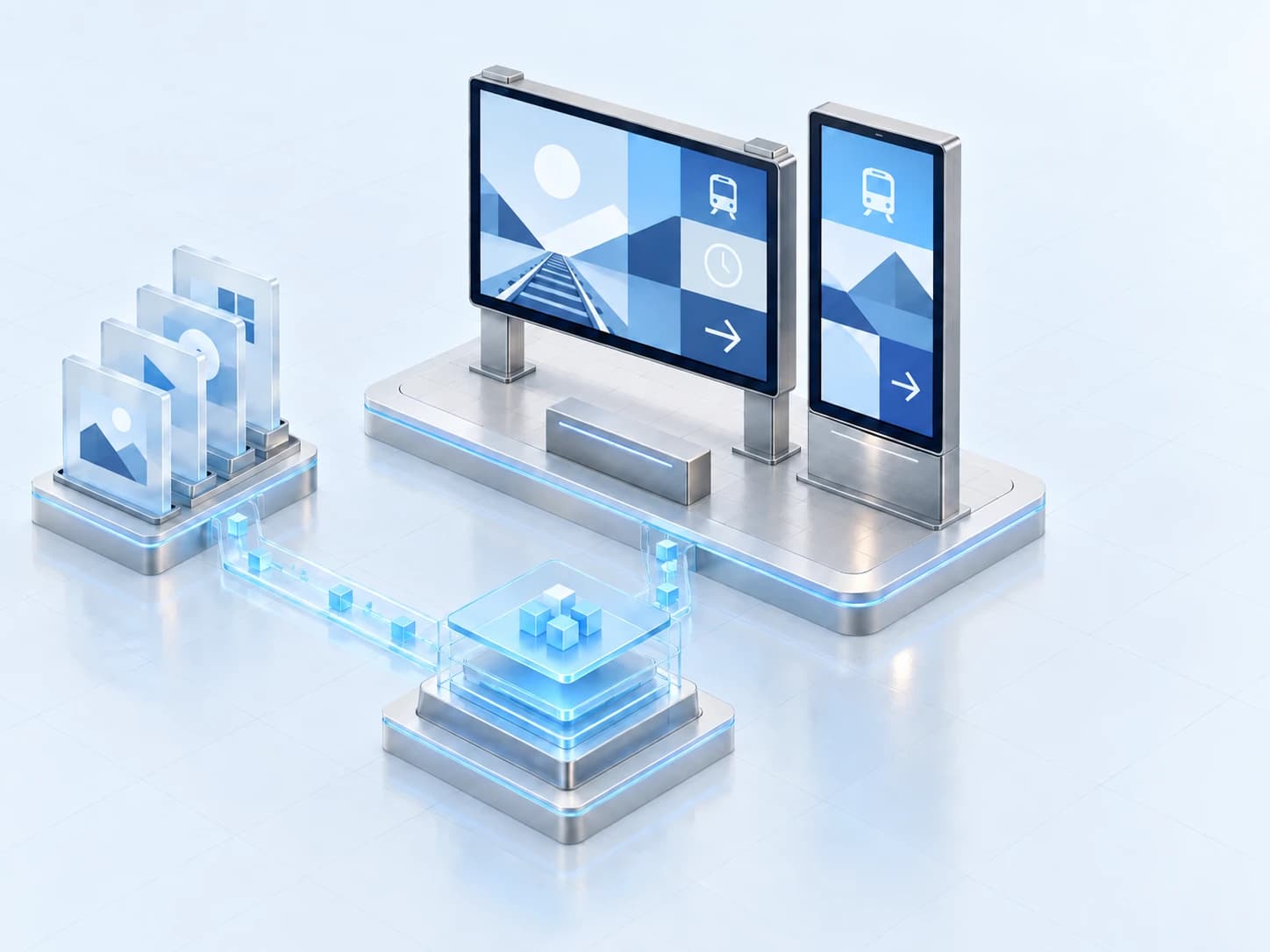
The application DuoByte helps develop follows the same principle. Directus serves as the CMS where content is managed and provided. A frontend built with Next.js and TypeScript renders that content on the displays.
Challenge
The application already exists, and additional requirements for managing and delivering content are being added. The task is therefore not a rebuild but the extension of an existing system whose structure stays in place.
A new content requirement can affect both sides. Whatever editors are supposed to maintain in the CMS, the frontend has to display correctly, or the data model and the display drift apart. That is why the CMS and the frontend are considered and extended together.
Digital signage adds its own constraints. Nobody uses a display the way they use a website: no one clicks, scrolls or reloads the page. Content has to appear on screen and make sense without any action from the viewer.
Solution
DuoByte adds new features to the existing Directus CMS and the Next.js frontend. On the CMS side, this concerns how content is managed and provided; on the frontend side, how it is presented on the displays.
This way, additional content management and delivery requirements flow into the existing application instead of a second solution growing next to it. Editors keep working in the CMS they know, and the displays keep getting their presentation from the same frontend.
Implementation
The architecture keeps content and presentation clearly apart. Directus manages and provides the content, and the frontend built with Next.js and TypeScript renders it on the displays.
DuoByte implements each new feature in the layer the requirement affects: in the CMS where content is maintained, in the frontend where it becomes visible. Extensions build on the application's existing structure and fit into the current codebase.
Outcome
The engagement is set up for the application's ongoing development. Additional content management and delivery requirements end up in the existing application: content is still maintained in Directus and presented on the displays through the same Next.js frontend.
System architecture
Technologies were combined to suit the task, operating model and long-term maintainability.
Related services
Keep exploring
Next case study

Your project
Tell us what your system needs to do. We bring structure to requirements, architecture and delivery.