
The same data is entered several times
An order is created in the CRM, entered again in the ERP and typed a third time for the invoice. Every transfer is a chance for typos and outdated records.
Interfaces and process automation
We connect ERP, accounting, payment providers and long-standing databases so that data is entered once and arrives correctly everywhere. That includes imports from PDFs and files, synchronization between systems and automated jobs for work someone currently does by hand. Every integration is documented and reports errors instead of silently losing data.
Typical starting points
Most companies have enough software. What is missing are the connections between the systems, and people fill that gap by copying, retyping and reconciling.
An order is created in the CRM, entered again in the ERP and typed a third time for the invoice. Every transfer is a chance for typos and outdated records.
Price lists, delivery notes or forms arrive as PDFs in all kinds of layouts. At Agilico, media price lists came as heterogeneous publisher PDFs whose prices, formats, circulation figures, discounts and surcharges had to be turned into structured data.
A new system is needed, but the existing company databases stay in use and have to be integrated. At ADG Sales, the backend of the new platform connects MongoDB with multiple existing MySQL company databases.
Monthly billing, confirmation emails or data reconciliation only happen when the responsible person remembers. If that person is out, the work piles up, and the gap is often noticed late.
What we build
We integrate through official APIs where they exist, and through databases, files or SFTP where they do not. What matters is that every connection works traceably and can be verified.
We connect systems such as ERP, CRM or accounting software through their interfaces and synchronize master data, orders and financial documents. At Agilico, quotations created on the platform are synchronized with Bexio.
An import checks sources for new documents, classifies them and transfers the relevant values into a fixed data format. For Agilico, an automated import monitors publisher sites, detects new price lists and turns them into structured product records.
If a legacy system has no API, we access its database in a controlled way or exchange files via SFTP. At ADG Sales, the backend groups each purchase by company and creates sales contracts and order lines in each company database within one transaction. If any step fails, everything is rolled back.
Recurring tasks such as reconciliations, reminders or billing run on a schedule or are triggered by events. In Praxisnetz Nürnberg Süd, every successful referral produces sequential invoice numbers and two role-specific PDF invoices without anyone having to start the process. At ADG Sales, scheduled jobs check expiring distribution rights, create proforma and final invoices and send reminders.
We process events from payment providers and third-party services through signature-verified webhooks. That keeps payments, subscriptions and account activations consistent without anyone reconciling them by hand.
Employees sign in with their existing Microsoft account instead of managing yet another password. Agilico's platform is connected to Microsoft sign-in for exactly this purpose.
Approach
Integrations rarely fail because of the code. They fail because of unclear ownership between systems and error cases nobody considered, so we clarify both before writing any integration code.
We document where data originates, which system is authoritative for which field and who transfers what today. Only then is it clear whether a sync, an import or an event is the right mechanism.
We check documentation, access options, rate limits and test environments of the target systems early with a technical spike. That way, limitations of an ERP or API surface before they dictate the schedule.
We specify what happens when a system does not respond, a record is incomplete or two sources contradict each other. Every run is logged, and failed operations can be retried selectively.
New automations initially run alongside the previous manual process until the results match. We then hand over documentation on data mapping, configuration and error handling so your IT team understands the pipeline and can look after it.
Technology
We usually build interfaces and jobs in TypeScript on Node.js, and in Python for document processing and data preparation. Incoming data is validated against schemas, for example with Zod, before it reaches PostgreSQL. At Agilico, Python libraries such as PyMuPDF and pdfplumber process the publisher PDFs, while the OpenAI API supports the analysis.
Where language models evaluate documents, rules in code decide what is accepted, not the model: at Agilico, the model returns values against a fixed schema, and an import without placements never overwrites a complete record. In Praxisnetz Nürnberg Süd, address autocomplete via OpenRouteService runs through the backend, so the API key never reaches the browser. Services run in Docker containers and are delivered through GitHub Actions.
Case studies
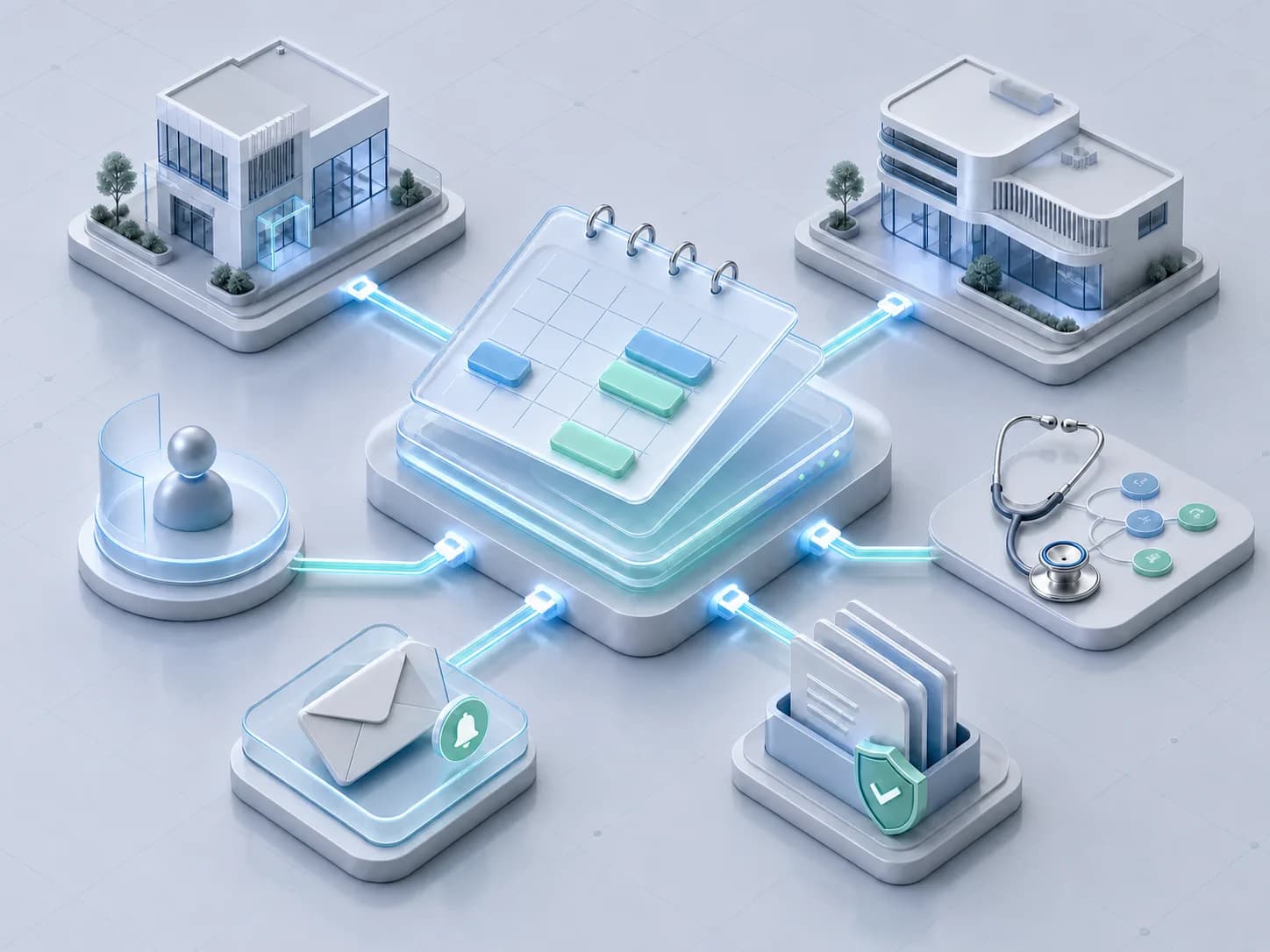
A PDF import connected to Bexio, a platform built on several existing company databases and automated billing between medical practices. The case studies show how the data flows are structured.
 Media & Advertising
Agilico GmbH
An end-to-end platform for media price lists, quotations, publication planning and production-ready ad orders
 Automotive Industry
ADG Sales GmbH
An integrated platform for brand experience, dealer operations, vehicle commerce and aftersales
 Healthcare
Praxisnetz Nürnberg Süd e.V.
Regional appointment exchange for medical practices with specialty-based search, secure booking and automated billing
Frequently asked questions
The decisive factors are the quality and documentation of the APIs involved, data volumes, the number of error cases and security requirements. That is why we do not quote flat prices. In a free 30-minute call, we assess your project, if you like after a short look at the API documentation, and you then receive a transparent proposal covering approach, milestones and billing.
Often, yes. Depending on the system, we use database access, file exports, SFTP or existing import functions, each with clear rules about what may be read and what may be written. Before implementation, we check whether the route is stable and permitted by the vendor.
Structured values such as prices, quantities or dates can be extracted automatically with good results when plausibility checks validate the output. At Agilico, an OpenAI-assisted analysis extracts prices, formats, circulation figures, discounts and surcharges from publisher PDFs into structured product data. Whether personal or confidential documents may be sent to an external AI service is something we clarify with you up front.
Every integration is built so that a failure gets noticed and leaves no half-written records. Failed operations are logged and can be reprocessed, and your team is notified when needed. If a provider changes its API, the error messages show it, not incorrect numbers. At ADG Sales, master data syncs with the MySQL databases are built so that an error on that side never blocks work in the portal.
Yes, for integrations that is the norm. We coordinate access, test environments and data mapping directly with your IT team or the system partner, with no project manager in between. In the end, everyone involved receives the same documentation of the interface.
Initial consultation
Name the systems involved and the step that is done manually today. In the free 30-minute call, the founders tell you which integration is technically feasible and where the risks are. We reply to every inquiry within 24 hours.
More services
Internal tools, dashboards and SaaS products that follow your processes instead of bending them. Designed and coded by the founders themselves.
Learn moreProtected portals for customers, dealers and members: orders, bookings and documents as self-service, with clear roles and permissions.
Learn moreWCAG 2.2 AA audits, fixes in the source code and automated CI checks for web apps, portals and online shops that fall under Germany's BFSG.
Learn moreBackend experience from Germany's ePA, an appointment platform for a practice network, and architectures that account for GDPR Article 9 and Section 393 SGB V.
Learn more