
Partner
Styropor Recycling Management und Beratung UG
Case study15
React-based corporate website for styrofoam recycling with Google Analytics and Docker deployment

Partner
Styropor Recycling Management und Beratung UG
Industry
Environmental & Recycling
Core technologies
React · TypeScript · HTML5
At a glance
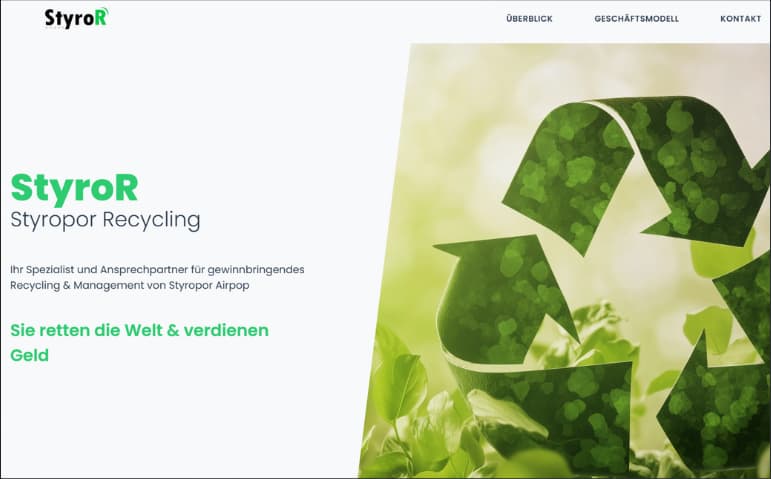
Styropor Recycling Management und Beratung UG (StyroR) in Hamburg recycles Styrofoam, XPS and other foam materials for businesses, including material contaminated with the flame retardant HBCD. DuoByte built its website with React and TypeScript and set it up so search engines receive every page as finished HTML with its own meta tags and structured data.
Our role: DuoByte developed the website, prerendered it for search engines, automated its deployment and maintains its content and contact details.
Project work
How the project came together: from the context and requirements through implementation to where it stands today.
Context
StyroR accepts expanded polystyrene (sold as Styropor or Airpop), extruded polystyrene (XPS), EPP, EPE and PUR, even when it is dirty or contains the flame retardant HBCD. The material is shredded, compressed into blocks and transported for recycling. Customers are businesses that deal with transport packaging from electronics and food logistics or with insulation from construction sites.
People who need to get rid of Styrofoam usually search by material and location. So the website first has to be found and then lead straight to an inquiry.
Challenge
A React application initially serves a nearly empty HTML shell and builds its content in the browser. Visitors do not notice, but search engines and link previews do: the title, description and structured data need to be in the delivered HTML of every single page.
At the same time, operations had to stay lean. The site runs as a container on its own server, and changes to content or contact details should go live without manual steps.
Solution
The home page explains which materials StyroR accepts, including dirty or contaminated ones, and why recycling is an alternative to incineration for businesses. A separate page walks through the recycling process step by step, from volume reduction and pressing into blocks to reuse of the material, with images that open in a larger view.
On the contact page, prospects can reach the company by phone, email or WhatsApp. The WhatsApp button opens the app on a phone and WhatsApp Web on a desktop, so customers can send a photo of their material right away. A legal notice and a privacy policy complete the five pages.
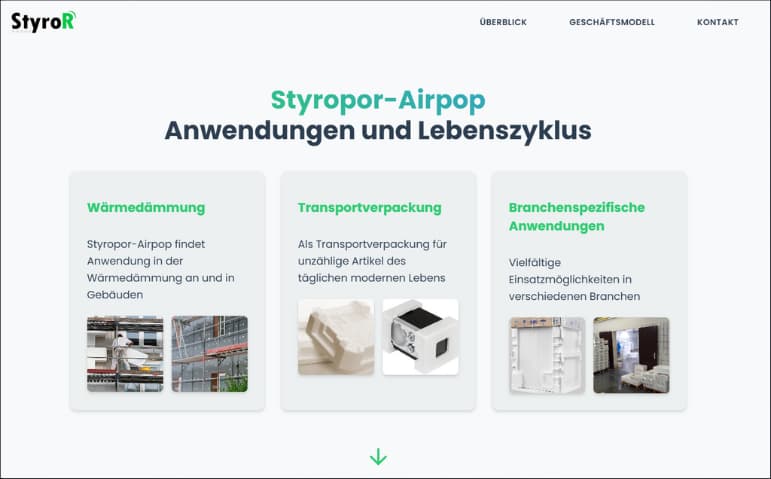
To help prospects recognize their own situation, the website shows typical applications the material comes from.
Implementation
Title, description and canonical URL are defined centrally for each route. After the build, react-snap prerenders all five routes in a headless browser and saves them as static HTML with inlined CSS. Because the meta tags from React Helmet are not carried over in that step, a custom script then writes the title, description, canonical URL, Open Graph tags and JSON-LD into each page.
The structured data describes StyroR as a local business serving Hamburg, its recycling services as an offer catalog and the page hierarchy as breadcrumbs. When contact or location details change, DuoByte updates the pages, legal notice and structured data together so search engines never see conflicting information.
Images are served as WebP, and most of them load only when scrolled into view. A sitemap listing all five pages and the robots.txt point search engines to the content.
The site is served by Nginx in a Docker container. Known routes point directly to their prerendered HTML, unknown paths return a real 404 status instead of the home page, and text files are compressed. Since June 2026, a GitHub Actions workflow handles the build, prerendering, image creation and container restart on every push, steps that previously followed a manual checklist. Google Analytics, loaded through Google Tag Manager, records visits.
Outcome
StyroR has a website whose pages reach search engines with full content, their own titles and structured data, and through which prospects can call, write or send a photo in one click. Changes, most recently to contact and location details, go live through the automated pipeline without anyone touching the server by hand.
Product & context
Selected views show how the system was conceived and implemented within its domain context.
System architecture
Technologies were combined to suit the task, operating model and long-term maintainability.
Keep exploring
Next case study

Your project
Tell us what your system needs to do. We bring structure to requirements, architecture and delivery.